

Abstract
Household food and nutrition security relies heavily on rural food production and this substantially contributes to alleviating poverty. Consequently, sustainable production of food and adequate postharvest management leads to food security. In many of the countries, the diminishing capacity of agriculture in providing for household subsistence increased the workload shouldered by women as men withdrew their labour from agriculture and sought greener pasture in white collar jobs in cities and towns. Thus the focus on smallholder women farmers trained on grain value addition. A total of 90 smallholder women vegetable farmers were selected from three (3) villages of Ilorin East local government areas of Kwara State. Majority (96.1%) of smallholder women farmers are involved value addition for income generation, 98.3% belong to either women association, women farmers’ association or some other associations, the smallholder women vegetable farmers agreed that the knowledge gained from postharvest management training could be shared with other women (WS=2.91). A total of 58.3% women smallholder farmers trained on postharvest management of grains had high knowledge. The women indicated that the constraints to adoption of postharvest technologies as lack of training on postharvest handling and storage (WS=3.17), unavailability of the technologies needed (WS= 3.01) and acceptance by other members of the household (WS= 3.27). Empowering and supporting women smallholder farmers is an essential tool to increase adoption of postharvest technologies and increase food supply. Thus, focusing training on smallholder women involved in vegetable value addition is recommended.
Introduction
Food is a basic need of humans need and it is a major source of nutrients for human survival and existence. Food is highly important for human’s well-being and for economic contribution and productivity (Agada & Igbokwe, 2016). Its demand has generally grown faster than its total supply, and its loss due to postharvest ineptness has contributed immensely to food insecurity.
Food and nutrition security has over the years remained Africa’s most fundamental challenge to human welfare and economic growth. However, many people on the continent are unable to acquire and effectively utilize the food they need for a healthy life at all times. According to Peng & Berry, 2019, food and nutrition security is achieved when all people, at all times, have physical and economic access to sufficient, safe and nutritious food that meets their dietary needs and food preferences for an active and healthy life. This definition speaks volume of the multidimensionality of food security. However, the major elements of food security are; its availability, its accessibility, its utilization and its protection of access (Agada & Igbokwe, 2016). Food and nutrition security is the bridge between agriculture and health, a major compass in the food system. One of the foremost challenging issues in the world today is how to provide sufficient food to the geometrically increasing world population.
There are several interventions ranging from improved yield, climate change mitigation and government support that has improved agricultural productivity, yet malnutrition remains the world`s most serious health problem and it is the single biggest contributor to child stunting and death (FAO, 2021).
The problem of postharvest loss has remained a nagging issue to attaining food and nutrition security in Nigeria. The level of high poverty and food insecurity in Nigeria is alarming, (Ike et al., 2017) with approximately 15% undernourished population, that is, 29.4 million undernourished people despite being one of the largest economies in Africa (FAO, IFAD, UNICEF & WFP 2021). Postharvest loss is the measurable quantity and quality loss of products at any point along the postharvest chain. (Kikulwe et al., 2018). It inadvertently leads to significant food losses and economic losses (Gross et al., 2000).
Women play a vital role in agriculture, but are faced with persistent economic constraints, their empowerment can be a major contributor to increased income of smallholder farmers, reduced hunger, empowered and independent women farmers, built local capacity, and strengthened resilience to economic and environmental shocks. Women disproportionately experience postharvest losses because of the time constraints and their lack of decision-making powers and lack of access to postharvest management knowledge, storage and handling technologies.
The gendering of farming activities and household food responsibilities in Nigeria has led to the complicated restriction of women to equal benefits from training opportunities, resources and empowerment. Family structures in most rural communities are patrilineal and restrains access to empowerment to male farmers mostly.
There is a great need to empower women in agriculture to foster food and nutrition security in Nigeria. This need informed this particular study which will allow women smallholder vegetable farmers become equipped with knowledge on postharvest management of vegetables.
The specific objectives of the study were to: access the level of knowledge from training; assess the perceived benefits of the respondents from training; and identify the factors influencing the attendance of training and the acceptance of empowerment materials. The specific research questions were: assess the’ knowledge perception of postharvest management practices, examine the perceived benefit and to assessfactors influencing the acceptance of training and empowerment.
Material and Methods
The study was carried out in Kwara State, Nigeria. The State is in the North Central geo-political zone of Nigeria. It falls within the guinea savannah of the agro-ecological zones. She has a land area of about 36,825 Sqkm. Kwara State lies between latitude 9°25′35′′N and longitude 3°30′38′′E and it is bounded by Niger and Sokoto to the North; Oyo, Ondo and Edo to the South; Benue, Plateau and FCT to the East; and shares international boundary with the republic of Benin to the West. The 2018 population figure of Kwara State was estimated to be 3,390,188 people (http://www.citypopulation.de/php/nigeria).
training was carried out in Kwara State of Nigeria. The State comprises of 16 Local Government Areas and there was an initial need assessment that informed the training on postharvest management of the women vegetable framers. The trainings were done in 3 selected villages of the Ilorin East Local Government Area. The villages were Amoyo, Sentu and Ile-apa. A scheduled interview was conducted after training to know the level of knowledge gained from each training. Data was subjected to statistical analysis; percentages and mean were used to analyse the level of knowledge from training and other training needs. The settings for this research were within the selected communities. The facilitators were outreach staff from Nigerian Stored Products Research Institute (NSPRI) with collaboration from Nigerian Women in Agriculture (NiWARD) Kwara State branch. The sponsorship came from African Women in Agriculture and Research (AWARD)
A sample size of 20% of the population of women who cultivate and or sell vegetable in the selected villages was randomly selected from each of the 3 villages for training on postharvest management of vegetable. A structured interview guide was administered after the training to elucidate information used for the analysis and result determination of this study.
Results and Discussion
Knowledge rating of respondents on postharvest management
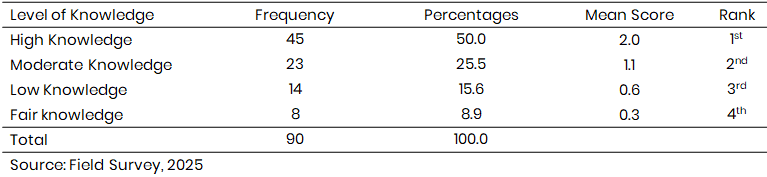
The result in Table 1 revealed the knowledge perception of respondent. There was a pre-test done to ascertain the level of the respondents’ knowledge on postharvest management of vegetable the result showed 10% of the respondent had knowledge in postharvest management of vegetable.
However, following the training, 50% of participants demonstrated a high level of knowledge, while only 8.9% showed fair knowledge. This notable shift indicates that the training program was highly effective in bridging existing knowledge gaps. The high mean score (2.0) for the “High Knowledge” category underscores the positive impact of the training on participants’ understanding and capacity to manage postharvest operations efficiently. Such improvement aligns with studies emphasizing capacity building as a key driver of postharvest innovation and loss reduction among smallholder farmers. This shows that the training was impactful and mostly important to the trainees.
Table 1: Knowledge Rating of Respondents on postharvest management
Respondents’ perceived benefits of training and empowerment
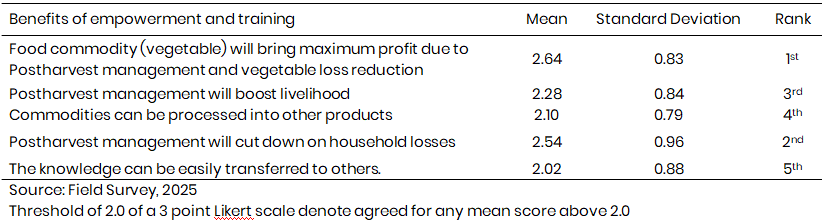
As shown in Table 2, participants strongly agreed that postharvest management significantly enhances profitability and reduces vegetable losses, reflected by the highest mean score (2.64). The second most acknowledged benefit was the potential of postharvest management to reduce household losses (mean = 2.54), followed by improvements in livelihood (mean = 2.28). Ersino et al., 2018 found that food security scores were better in households where women or both genders controlled farm produce, this indicates the importance of ensuring women’s access of postharvest resources will better position them for improved food and nutrition security.
The relatively lower mean for “knowledge transfer” (2.02) indicates that while participants gained practical skills, there remains a need to strengthen peer-to-peer learning and community-level dissemination of knowledge. Overall, these findings affirmed that training and empowerment not only improve technical skills but also boost economic sustainability and household food security.
Food commodity (vegetable) will bring maximum profit due to postharvest management and vegetable loss reduction, the women vegetable farmers will be able to increase their profit by adopting the use of empowerment.
Table 2: Respondents’ perceived benefits of training and empowerment
Factors influencing the acceptance of empowerment material
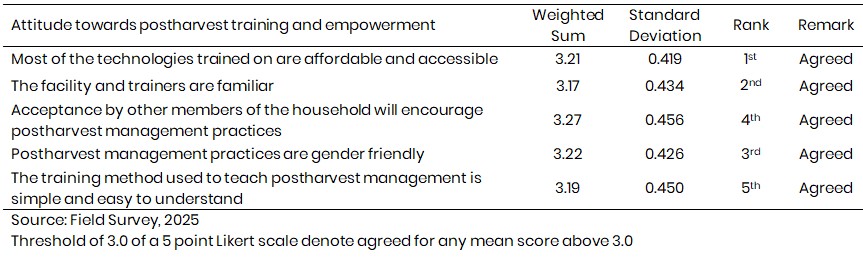
Table 3 demonstrates that respondents largely accepted the training and empowerment initiatives. High mean scores across variables indicate favorable attitudes: affordability and accessibility of technologies (3.21), familiarity of trainers and facilities (3.17), and the gender-friendly nature of practices (3.22). Importantly, the agreement that household acceptance encourages postharvest adoption (mean = 3.27) suggests that social influence and household support play critical roles in sustaining behavioral change. The simplicity of training methods (3.19) further supports inclusivity and comprehension among rural women participants.
Therefore, acceptance by other members of the household will encourage postharvest management practices and the acceptance and use of postharvest technology.
Table 3: Factors influencing the acceptance of empowerment material (vegetable baskets)
Factors influencing the attendance of postharvest management training by smallholder women vegetable farmers
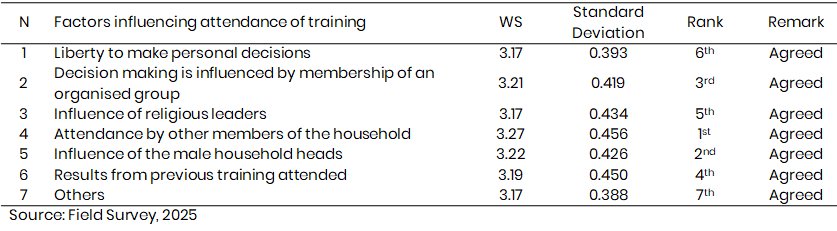
The respondents as shown on Table 4 agreed to a list of factors influencing their attendance of training and empowerment programs. It shows the rank order analysis to determine factors that prompt respondent’s attendance of postharvest training on vegetable and empowerment with vegetable baskets. Almost all the respondents, agreed on the items of statement, however the three most agreed upon will be highlighted as follows from the 1st to 3rd: item 3 “Decision making is influenced by membership of an organised group” with a mean of 3.21; item 2 “Influence of the male household heads” with a mean of 3.22; item 1 “Attendance by other members of the household” with a mean of 3.27.
Table 4: Mean Rank Order and Standard deviation of response on factors influencing the attendance of training.
Conclusion
Reducing postharvest losses can be achieved through consistent and deliberate effort using training and empowering of stakeholders particularly smallholder women farmers as the women agreed that food commodity (vegetable) will bring maximum profit due to postharvest management and vegetable loss reduction. The method used should be a holistic approach that will involve all members of the households as attendance by other members of the household proved to be a strong factor in encouraging women’s participation in postharvest management practices among rural women in the study area. This might not literally mean all household members should attend training meant for women, but could mean informing and getting the consent of or raising the awareness about the training for all household members’ notice. Reducing postharvest losses and owning postharvest technologies has gained attention more among men than women. To ensure gender inclusiveness, women should be encouraged to own postharvest management technologies and participate in postharvest management training.
This study recommends that training women would be successfully conducted if the associations they belong to are used as avenue for invitation, and the male household heads are also contacted to prompt the women’s participation among other strategies. The inclusion of women in postharvest management will help improve household food security
References
Agada, M., & Igbokwe, E. (2016). Influence of food culture and practices on household food security in North Central Nigeria. Journal of Food Security, 4(2), 36–41.
Ersino, G., Zello, G. A., Henry, C. J., & Regassa, N. (2018). Gender and household structure factors associated with maternal and child undernutrition in rural communities in Ethiopia. PLoS ONE, 13(10), e0203914. https://doi.org/10.1371/journal .pone.0203914
Food and Agriculture Organization. (2021). Data: Suite of food security indicators. FAOSTAT. Retrieved July 12, 2021, from https://www.fao. org/faostat/en/#data/FS
Food and Agriculture Organization, International Fund for Agricultural Development, United Nations Children's Fund, & World Food Programme. (2021). The state of food security and nutrition in the world 2021: Transforming food systems for food security, improved nutrition and affordable healthy diets for all. FAO. https://doi.org/10.4060/cb4474en
Gross, R., Schoeneberger, H., Pfeifer, H., & Preuss, H. J. (2000). Four dimensions of food and nutrition security: Definitions and concepts. SCN News, 20, 20–25.
Copyright
Open Access: This article is licensed under a Creative Commons Attribution 4.0 International License, which permits use, sharing, adaptation, distribution and reproduction in any medium or format, as long as you give appropriate credit to the original author(s) and the source, provide a link to the Creative Commons license, and indicate if changes were made. The images or other third party material in this article are included in the article’s Creative Commons license, unless indicated otherwise in a credit line to the material. If material is not included in the article’s Creative Commons license and your intended use is not permitted by statutory regulation or exceeds the permitted use, you will need to obtain permission directly from the copyright holder. To view a copy of this license, visit http://creativecommons.org/licenses/by/4.0/.

