

Growth performance of broiler chickens fed various levels of African locust bean (Parkia biglobosa) based diets
Abstract
This experiment was conducted to evaluate the growth performance of broiler chickens fed various level of African locust bean (P. biglobosa) based diets. One hundred and twenty day old broiler chicks (marshal strain) were allotted to four dietary treatment in which African locust bean seed replace soybean as protein source at 0, 10, 20 and 30% levels coded as diets 1, 2, 3 and 4 respectively, The experiment was in a completely randomized design (CRD) with three replicates per treatment and ten birds per replicate. Feed and water were supplied ad libitum and the trial lasted for eight weeks. At the starter phase, daily feed intake (58.47-60.87 g), daily weight gain (16.19 - 18.39 g) and feed conversion ratio (3.22 - 4.02) were not significantly different. At finisher phase the daily feed intake (90.18-102.87 g) indicated significant difference (P<0.01) while the values of the daily weight gain (34.92 - 40.49 g) were significant in birds fed diet 4 and 3 respectively. However, feed conversion ratio did not show any significant treatment effect, the values ranged from (2.53 - 2.95). From these findings African locust bean meal can replaced soybean at 20% without any adverse effect on the performance of birds with concomitant reduction in cost.
Introduction
Poultry production is gaining popularity in the developing countries due to its role in bridging the protein nutrition deficit, resulting to economic empowerment of the resource poor segment of society (Gebremedhn and Alemu, 2015). Such growth in the poultry industry is having a profound effect on the demand for feed and raw materials. However, it is also becoming clear that the requirements for the four traditional feed ingredients (maize, soybean meal, fish meal and meat meal) cannot be met (Adewale et al., 2016). The gap between local supply and demand for these traditional ingredients are expected to be widening over the coming decades thus, providing a compelling reason for exploring the usefulness of locally available alternative feedstuffs in feed formulation (Adewale et al., 2016). The utilization of locust bean in monogastric nutrition as replacement for a protein source i.e groundnut cake was reported to improved production performance, nitrogen retention and feed utilization, with varied results (Bridget et al., 2004; Alabi et al., 2005). Ayanwale and Ari (2002) and Dawodu (2009) found a positive attribute for fermented locust beans as against the unfermented locust bean which was said to inhibit broiler growth due to less protein quality and essential vitamins (Fetuga et al., 1974). However, Anti-nutritional factors (ANFs) such as tannins oxalate and hydrogen cyanide had been reported to limit the utilization of locust bean as feed ingredient (Apata, 2003). Fermentation has been reported to destroy some natural toxins which may occur in beans, thereby improving the nutritive-value, digestibility and enhance growth of chickens (Bridget et al., 2004). This study was designed to evaluate the growth performance of broiler chickens fed various levels of African locust bean (P. biglobosa) meal.
Material and Methods
Experimental site
The experiment was conducted at the poultry unit of Abubakar Tafawa Balewa University Teaching and Research Farm, Bauchi. Bauchi State occupies a total land area of 49,119 km² representing about 5.3% of Nigeria’s total land mass and is located between latitudes 9° 3' and 12° 3' North and longitudes 8° 50' and 11° East.
Materials for experiment
Maize, soybean, locust bean, groundnut cake, fish meal, wheat offal, bone meal, limestone, lysine, methionine, salt and vitamin premix were bought from Muda Lawal market in Bauchi town. One hundred and twenty (120) day old chicks were obtained from Zatech Hatchery.
Management of the birds
The broiler chickens were brooded on deep litter for a week fed commercial diet containing 23% crude protein and 2900 kcal kg-1 ME. Heat was provided during the brooding with two charcoal stoves and 200 watts electric bulbs as sources of light and heat. After the brooding, birds were randomly assigned to four dietary treatments. Each treatment was replicated three times, vaccine were administered as required, feed intake was determined by subtracting the left over from the supply of the previous day. The weights of the birds were measured in groups immediately after the brooding period and weekly thereafter.
Experimental design
The experimental design used was Completely Randomized Design.
Experimental diets
Four experimental diets for both starter (23% CP) and finisher (20% CP) phase were formulated. Locust bean meal were included at 0, 10, 20 and 30% level as replacement for soybean, designated as diets T1, T2, T3 and T4 respectively for both starter and finisher phase.
Data collection
Birds performance Records of feed intake and body weight changes were taken daily and weekly respectively, feed conversion ratio was calculated using the values while mortality was recorded as they occurred.
Statistical analysis
The data obtained were subjected to analysis of variance (ANOVA) were significant difference occurred means, least significant difference (LSD) was used to separate them.
Results and Discussion
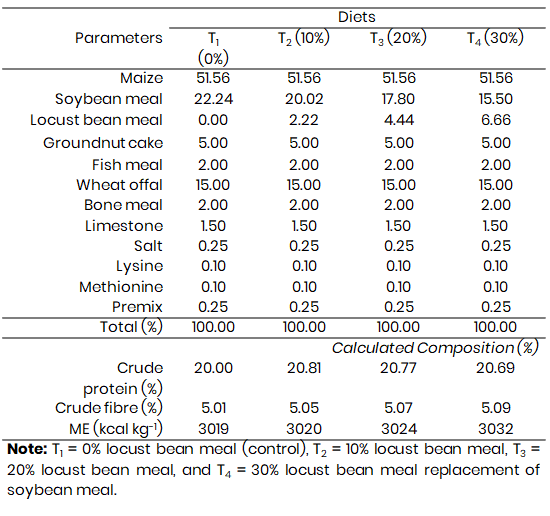
The ingredient composition of the experimental diets fed to broiler chickens during the starter (1–4 weeks) and finisher (5–8 weeks) phases is presented in Tables 1 and 2, respectively. Four dietary treatments were formulated by replacing soybean meal with processed locust bean meal at 0% (T1), 10% (T2), 20% (T3), and 30% (T4) levels.
Table 1: Percentage composition of experimental diets fed to broiler chickens at the starter phase (1-4weeks)
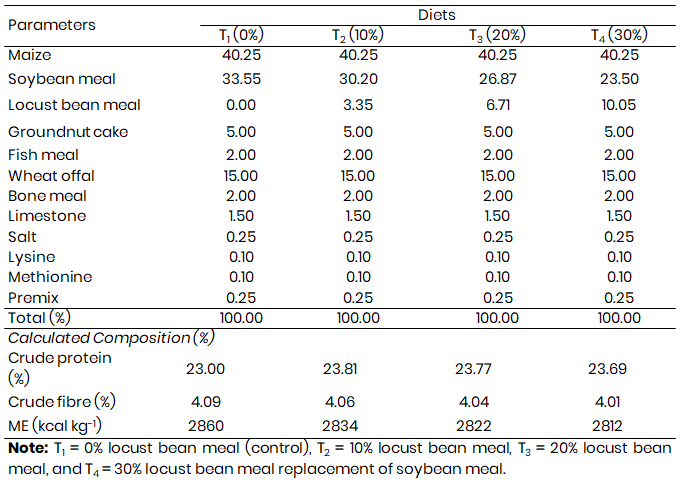
Table 2: Percentage composition of experimental diets fed to broiler chickens
At the starter phase, the inclusion of locust bean meal increased progressively from 0.00% in T1 to 10.05% in T4, while the soybean meal content decreased correspondingly from 33.55% to 23.50%. Other dietary ingredients remained constant across all treatments. The calculated crude protein content ranged from 23.00% in T1 to 23.81% in T2, with slight reductions to 23.77% and 23.69% in T3 and T4, respectively. Crude fibre values showed a marginal decline from 4.09% in T1 to 4.01% in T4. Similarly, metabolizable energy (ME) decreased slightly from 2860 kcal kg-1 in the control diet to 2812 kcal kg-1 in the diet containing 30% locust bean meal.
During the finisher phase, a similar trend was observed. The inclusion level of locust bean meal increased from 0.00% in T1 to 6.66% in T4, while soybean meal decreased from 22.24% to 15.50%. The crude protein content varied slightly among treatments, ranging from 20.00% in T1 to 20.81% in T2 and declining marginally to 20.69% in T4. Crude fibre content increased slightly from 5.01% in T1 to 5.09% in T4. Metabolizable energy values showed a gradual increase from 3019 kcal kg-1 in T1 to 3032 kcal kg-1 in T4.
The formulated diets at both starter and finisher phases maintained relatively similar nutrient compositions across treatments despite increasing levels of locust bean meal inclusion, indicating that the replacement strategy successfully produced nutritionally comparable diets for evaluating the effect of locust bean meal on broiler performance.
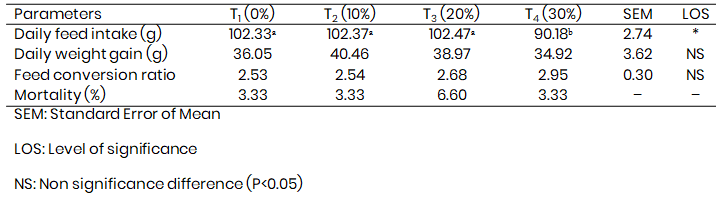
The performance of broiler chickens fed various levels of African locust bean (P. biglobosa) based diets for starter (1-4 weeks) were presented in Table 3. There was no significant (P>0.05) difference in the feed intake, weight gain, and feed conversion ratio between birds fed experimental diets implying that the inclusion levels of African locust bean (P. biglobosa) did not have any effect on these parameters. This is in line with the finding of Obun (2007) who reported no significant difference in feed intake among chickens fed graded level of fermented African locust bean (P. biglobosa) meal. Also the performance of broiler chickens fed various levels of African locust bean (P. biglobosa) based diets for finisher (5-8 weeks) were presented in Table 4. The feed intake were significantly affected by the dietary treatments (P<0.05) were birds on treatment 1, 2 and 3 were statistically similar and significantly higher than treatment 4 (30%). The daily weight gains were not significantly influenced by different dietary treatments. The observed increased feed intake of birds fed African locust bean meal as shown in Table 4 can be attributed to the less odour of locust bean meal due to low inclusion level which is 20%. At the level of inclusion 100%, the smell of the ALBM masked the smell of other ingredients making the diets unattractive and possibly unpalatable to the birds, while at 50% ALBM inclusion, birds can still tolerate the aroma (Aderemi et al., 2017). This result is also similar to the findings of Odunsi (2003) who reported that feed intake by animal’s increases if the aroma of their diet is acceptable. However, the better FCR may be due the low inclusion level of locust bean 20% which make the diet to be more palatable and acceptable.
Table 3: Performance of broiler chickens fed various level of African locust bean at the starter phase (1-4 weeks)
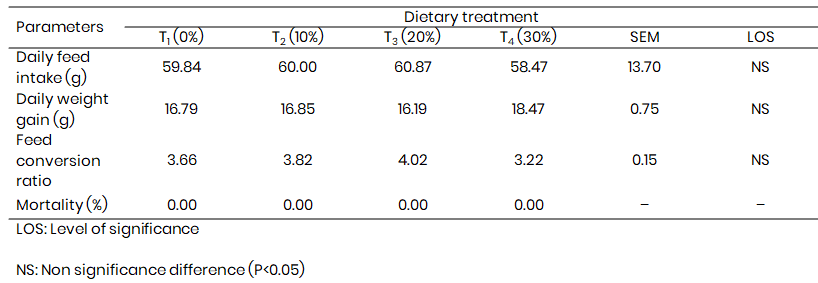
Table 4: Performance of broiler chickens fed various level of African locust bean at the finisher phase (5-8 weeks)
Conclusion
It can be concluded that the African locust bean seed can replace soya bean at 20% level as sources of protein in broiler diets at both starter and finishing phase without any detrimental effect on the performance of broiler chickens hence the use of African locust bean seed could be well advocated and recommended to served as an alternative protein source for soya bean at up to 30% level. Thereby reducing completion and improving consumer access to animal protein.
References
Adewale, R. T., Adeyinka, O. A., Akinyinka, A. O., Damilola, O. O., & Joseph, A. O. (2016). Response of broiler chicken to parboiled mango seed kernel meal (PMKM) based diet fortified with vitamins. International Journal of Livestock Research, 6(11), 25–30.
Aderemi, F. A., Ayoola, M. O., Alabi, O. M., & Oyelami, L. O. (2017). Evaluation of fermented locust bean meal (Parkia biglobosa) as replacement to soybean meal in production performance, blood profile and gut morphology of broiler chicken. Journal of Livestock Science, 8, 28–34.
Alabi, D. A., Akinsulire, O. R., & Sanyaolu, M. A. (2005). Qualitative determination of chemical and nutritional composition of Parkia biglobosa (Jacq.) Benth. African Journal of Biotechnology, 4, 812–815.
Apata, D. F. (2003). Egg production and haematological profile of laying hens fed dietary raw or processed Prosopis africana seeds. In Proceedings of the 28th Annual Conference of the Nigerian Society for Animal Production (NSAP) (pp. 280–282). Nigerian Society for Animal Production.
Copyright
Open Access: This article is licensed under a Creative Commons Attribution 4.0 International License, which permits use, sharing, adaptation, distribution and reproduction in any medium or format, as long as you give appropriate credit to the original author(s) and the source, provide a link to the Creative Commons license, and indicate if changes were made. The images or other third party material in this article are included in the article’s Creative Commons license, unless indicated otherwise in a credit line to the material. If material is not included in the article’s Creative Commons license and your intended use is not permitted by statutory regulation or exceeds the permitted use, you will need to obtain permission directly from the copyright holder. To view a copy of this license, visit http://creativecommons.org/licenses/by/4.0/

